+91 799 591 7995
Mon - Sat: 9:00am to 6:00pm

4th floor, ARD MAGNUM, Green Hills Road, Moosapet, Kukatpally, Hyderabad
+91 799 591 7995
Mon - Sat: 9:00am to 6:00pm
4th floor, ARD MAGNUM, Green Hills Road, Moosapet, Kukatpally, Hyderabad

Best Cataract Surgery hospital in Hyderabad with experienced cataract surgery specialists.
Get rid of blurred vision with our advanced cataract surgery.



Having basic information about Cataract on hand before the appointment with the Ophthalmologist will help you have a productive conversation with him, understand your options and quickly make a decision. Here you will find the ABCs of Cataract.
When the external source of light enters through the cornea in our eyes, passing through the natural lens and finally focusing on the retina, you will have a clear vision. And when the natural lens in the eyes becomes cloudy, the individual will have blurred or fuzzy vision. This condition is a progressive disease, which cannot be corrected with medications. Surgery is the only way a cataract patient can restore clear vision.
Several factors could lead to Cataract:
Cataract imposes a lot of acute and long-term symptoms that you need to be aware of. Some of the most common symptoms of this disease include:
During cataract surgery, the Ophthalmologist will replace the cloudy natural lens in the patient's eye with an artificial intraocular lens (IOL). The surgery corrects the focus of the light onto the retina and allows the patient to have a crystal clear vision instead of struggling with cloudy and fuzzy vision. In most cases, the new lens restores the complete vision of the patient. However, some patients need glasses to read or drive. We at Think Eye Hospitals offering Cataract Surgery at Affordable Cost in Hyderabad.
As for the type of lenses that are used, they include two options:
Aside from these, there are few distinctive types of lenses that the surgeons use to replace the affected natural lens. They are:
The type of cataract surgery depends on the degree of damage. Your consulting Ophthalmologist will first assess the condition, learn about a brief rundown of your lifestyle and medical history before suggesting the best surgery for your Cataract. That aside, there are two primary types of surgeries to correct the condition of Cataract:
Small Incision Cataract Surgery (SICS)
This type of surgery is prescribed for patients whose extent of the Cataract has gone out of hand and has become excessively hard. In this procedure, the Cataract is removed manually by the surgeon by making an incision.
Phacoemulsification
Phacoemulsification is one of the cutting-edge techniques wherein a tiny instrument is inserted through a small incision. Using the instrument, ultrasound vibrations are pulsated to break down the Cataract into smaller pieces and suctioned out of the eyes. This is a minimally invasive procedure that doesn’t involve permanent risks. The recovery period is also significantly less in this surgery.
One of the most advanced options available today is laser-assisted phacoemulsification. In this procedure, ultrasound technology is used to break up the cloudy lens through a very small incision. It’s minimally invasive, offers quick recovery and has a very low risk of infection. The natural lens is replaced with an intraocular lens (IOL), such as monofocal or multifocal, to restore clear vision.
Start by looking for a specialist who has strong experience in phacoemulsification and different types of IOLs. A good doctor won’t just suggest surgery, they’ll evaluate your lifestyle, medical history and the severity of your cataract before recommending the most suitable option. High success rates and patient feedback are also important factors to consider.
Many well-equipped eye hospitals near Moosapet provide comprehensive eye care, including cataract surgery, glaucoma management and retina treatments. This is especially helpful because conditions like glaucoma and retinal issues are often linked with aging or diabetes and can be addressed together during evaluation and treatment.
Modern techniques like phacoemulsification are far more comfortable compared to traditional methods. They avoid large incisions and manual removal of the lens, which means faster healing and less downtime. The precision of laser-assisted technology also improves outcomes, especially if you’re dealing with symptoms like blurred vision or difficulty seeing at night.
Procedures like LASIK for myopia and phacoemulsification for cataracts both offer quick recovery times. Most patients can get back to their normal routine within a few days. However, cataract surgery focuses on replacing the cloudy lens due to aging, while myopia treatment corrects refractive errors. Many eye centers offer both, making it easier to manage multiple vision concerns in one place.
Our specialists at Think Eye have treated over 35000+ patients and we have gained tens of thousands of loyal brand ambassadors over the decades. Listen to what our brand ambassadors have to say about our services…
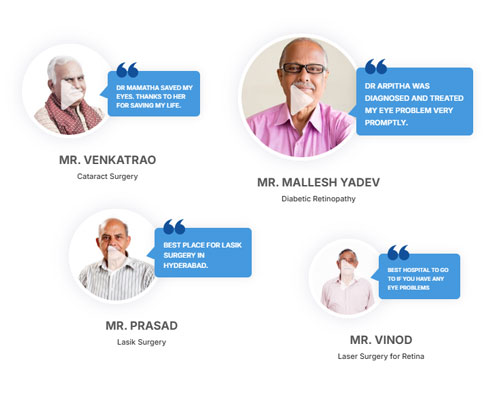
I had the great experience with Think Eye Hospitals. My father had laser cataract surgery without complication. Dr. Mamatha took good efforts to explain the procedure and everything is transparent. Friendly staff and...
I went for a second opinion to Think Eye... My initial though was to get a second opinion and go back to the first doctor for surgery. But Dr mamatha captured my trust...