+91 799 591 7995
Mon - Sat: 9:00am to 6:00pm

4th floor, ARD MAGNUM, Green Hills Road, Moosapet, Kukatpally, Hyderabad
+91 799 591 7995
Mon - Sat: 9:00am to 6:00pm
4th floor, ARD MAGNUM, Green Hills Road, Moosapet, Kukatpally, Hyderabad



Hyperopia is a vision condition where the patient cannot see close objects and cannot read letters from a close distance. The close objects appear blurred to the patient. It is also called farsightedness or long sight. Farsightedness affects the focusing ability of the eyes. The eye focuses better on distant objects than close objects.
Hyperopia is caused due to the shape of the cornea. If the cornea is not smoothly curved, the light rays do not fall properly on the cornea and fall behind the retina. It makes close objects blurred. When the distant objects are seen, the distant light rays refract from the cornea and make the distant view clearer. Hyperopia is also caused if the eyeball is shorter than normal. It is the opposite of myopia or short-sightedness.
Hyperopia is classified into two types based on the structure or function of the eye.
Hyperopia is classified into three types based on the degree of the vision it has affected. If the degree of the affected vision is below two diopters, it is called low hyperopia. If the degree of the affected vision is between two to five diopters, it is called moderate or medium hyperopia. If the degree of the affected vision is above five diopters, it is called high hyperopia.
If you face any or all the symptoms, please get your eye examination for hyperopia without delay.
Kids above seven years are asked to wear glasses or lenses as per their visual power while reading, writing, or doing any activity requiring eyes to function closely. They should be taken for a periodic eye examination to check if there is any power variation. If the hyperopia is left untreated or unnoticed, it may affect the child’s visual system and eventually results in other eye disorders such as amblyopia, strabismus, decreased quality of life, learning problems, etc.
Hyperopia is treated according to the degree of the affected vision. People with low hyperopia are recommended to get contact lenses or glasses with low power. As the degree of the affected vision increases, the power of the lenses and glasses keeps on getting stronger. For people whose degree of vision is above five diopters, vision correction surgery called LASIK is recommended by ophthalmologists to correct the vision.
Advanced hyperopia treatment focuses on correcting farsightedness by improving how light is focused onto the retina. This can be done using glasses, contact lenses or refractive procedures like LASIK. Along with these treatments, regular eye check-ups help reduce eye strain and improve near vision for everyday activities.
Hyperopia treatment mainly helps improve near vision, while myopia treatment focuses on correcting distance vision. Both conditions may require glasses or contact lenses, but the prescription and follow-up plan differ. In hyperopia, the eye is shorter than normal, whereas in myopia, the eye is longer, so treatment is tailored accordingly.
If you depend heavily on glasses, experience frequent eye strain or want more freedom in daily life, you might consider advanced options like LASIK. An eye specialist will evaluate your corneal thickness, pupil size and overall eye health to determine whether surgery is safe and suitable for you.
Hyperopia in children can lead to eye strain, difficulty in reading and poor school performance. If left untreated, it may also increase the risk of conditions like amblyopia (lazy eye) or strabismus (eye misalignment). Early detection and treatment help ensure proper vision development.
People with a stable prescription, healthy corneas and no major eye diseases are usually good candidates. An eye specialist will assess your vision needs, lifestyle and overall eye health before recommending whether advanced treatment or continued use of glasses is the better option.
Our specialists at Thinkeye have treated over 35000+ patients and we have gained tens of thousands of loyal brand ambassadors over the decades. Listen to what our brand ambassadors have to say about our services…
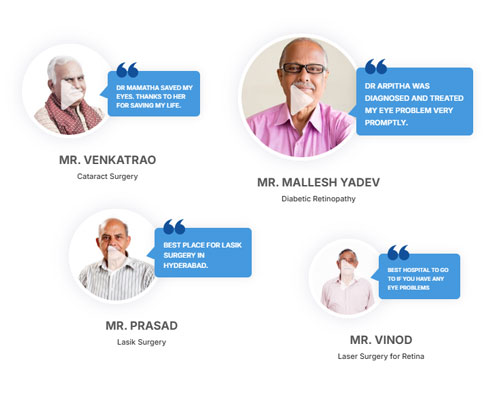
I had the great experience with ThinkEye Hospitals. My father had laser cataract surgery without complication. Dr. Mamatha took good efforts to explain the procedure and everything is transparent. Friendly staff and...
I went for a second opinion to thinkeye... My initial though was to get a second opinion and go back to the first doctor for surgery. But Dr mamatha captured my trust...